Company new
Complete equipment for steelmaking, ironmaking, and steel rolling
TANGSHAN FENGRUN DISTRICT RUNHAO ROLLING MACHINERY CO., LTD. can provide a complete set of equipment for ironmaking, steelmaking, continuous casting, and steel rolling
Raw material: iron ore
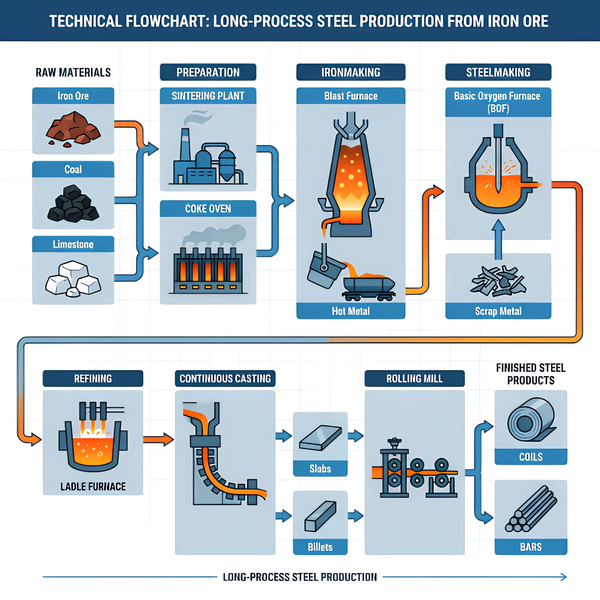
1. Raw Materials: Shows Iron Ore, Coal, and Limestone.
2. Preparation: It includes Sintering Plant and Coke Oven.
3. Ironmaking: The core is the Blast Furnace, which produces Hot Metal.
4. Steelmaking: Scrap Metal is added to the Basic Oxygen Furnace (BOF) to produce crude steel.
5. Refining: Conducting fine adjustments to the composition through the Ladle Furnace.
6. Continuous Casting: Continuous casting produces slabs or billets.
7. Rolling Mill: Finally, the steel is processed into finished steel products through the rolling mill.
Detailed description of the entire process of steel production
1. Preliminary preparation: raw material processing (Raw Materials & Preparation)
Before entering the core process, the physical and chemical properties of the raw materials must be optimized.
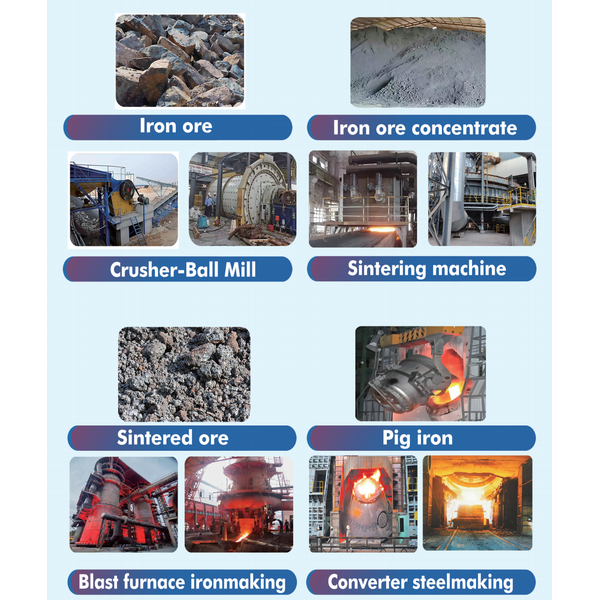
1. Sintering: Mixing fine iron ore powder with limestone and coal powder, igniting and drawing air on a sintering machine, sintering into "sinter" with sufficient strength and permeability, which serves as the main iron-based raw material for blast furnaces.
2. Coking: The process of heating coking coal in a coke oven in the absence of air (dry distillation) to remove volatile components and produce "coke". Coke serves as a heating agent, reducing agent, and also provides the structural support for the burden column in a blast furnace.
II. Ironmaking Process (Blast Furnace)
The goal of ironmaking is to reduce iron oxides in iron ore to metallic iron.
Core equipment: Blast Furnace.
Process: Sinter, coke, and flux are added from the top of the furnace, and high-temperature hot air is blown in from the bottom. The reducing gas (CO) produced by the combustion of coke captures the oxygen in the iron ore during its ascent.
Product:
Hot Metal/Pig Iron: It has a high carbon content (about 4%) and contains impurities such as sulfur and phosphorus.
Blast furnace slag (Slag): A by-product generated by the reaction between gangue in ore and flux, used for building materials.
III. Steelmaking Process (BOF/EAF)
The essence of steelmaking lies in "decarbonization" and "impurity removal", transforming pig iron into steel with elasticity and toughness.
1. Basic Oxygen Furnace (BOF):
Pour the molten iron from the blast furnace and a certain proportion of scrap steel into the converter.
Introduce high-pressure pure oxygen to oxidize elements such as carbon, silicon, and manganese in the molten iron, releasing heat without the need for external fuel.
Slagging: Add lime and other substances to remove harmful elements such as phosphorus and sulfur.
2. Secondary Refining / Ladle Furnace:
The molten steel after initial melting is poured into a ladle and undergoes minor composition adjustments in a refining furnace.
Function: Deep desulfurization, degassing, removal of inclusions, and precise adjustment of alloy composition (such as adding chromium, nickel, molybdenum, etc.) to produce steel of specific grades.
IV. Continuous Casting Process (CCM)
Convert liquid steel into solid semi-finished billets.
Core equipment: Continuous Casting Machine.
Process: Molten steel flows from the ladle through the tundish and enters the mold. Its surface is hardened by intense water cooling, then it is pulled out and further cooled by water spraying to achieve complete solidification.
Semi-finished Products:
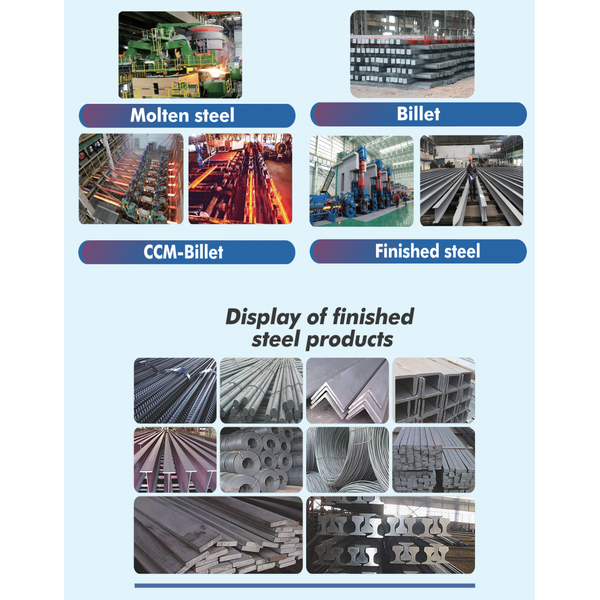
Billet: used for producing wire rods and deformed steel bars.
Slab: Used for producing hot-rolled coil and heavy plate.
Bloom: Used for producing large-sized steel shapes, rails, etc.
V. Steel rolling process (Rolling)
By altering the shape and internal microstructure of the steel billet through mechanical pressure, its final performance characteristics are imparted.
1. Heating: The billet enters the heating furnace and is reheated to the austenitizing temperature (approximately 1100℃-1250℃).
2. Hot Rolling: The billet passes through multiple sets of rotating rolls, gradually becoming thinner and longer under pressure.
Rough rolling: Conduct large reduction in thickness.
Finishing rolling: Precisely control the final dimensions and surface quality.
3. Cooling and collection: Control the microstructure of steel through laminar cooling, and finally coil (for plates) or cut to length (for long products).
Finished product form:
Long Products: such as rebar, round steel, and wire rod.
Flat Products: such as Hot Rolled Coil and Medium and Heavy Plate.
Structural Shapes: such as I-beam and H-beam.
Summary of process flow
Iron ore + coke → blast furnace (ironmaking) → molten iron → converter (steelmaking) → molten steel → continuous casting (billet formation) → rolling mill (finished product)
Introduction to scrap steel melting process using medium frequency induction furnace
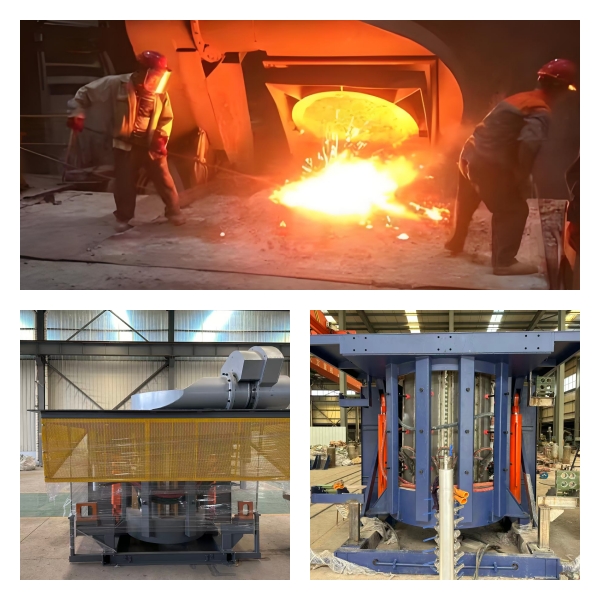
Medium frequency induction melting is a process that utilizes electromagnetic induction to heat and melt scrap steel. It differs from traditional ironmaking using fossil fuels and also differs from electric arc furnaces (EAFs) that rely on arc discharge, presenting its unique application scenarios.
1. Core principle: Electromagnetic induction
An induction furnace generates an induction magnetic field through an induction power supply (typically 50Hz to 10kHz). When magnetic field lines pass through the metal scrap inside the furnace, eddy currents are induced within the scrap steel. According to Joule's law, the heat generated by the eddy currents directly melts the metal.
II. Process flow
1. Scrap Preparation:
Classify, crush, and briquet the scrap steel.
Due to the limited ability of medium-frequency furnaces to remove impurities, the purity of raw materials (such as being free of oil stains, coatings, and minimal rust) is of utmost importance.
2. Charging: Put scrap steel into the crucible in batches.
3. Melting: Turn on the power for induction heating. As the bottom layer of scrap steel melts, the liquid metal forms a molten pool, accelerating the melting of subsequently added scrap steel.
4. Slagging: Add a small amount of slagging agent to make impurities float on the surface, and then remove the slag manually or through mechanical devices.
5. Alloying: During the later stage of melting, ferroalloys (such as ferromanganese, ferrosilicon, ferrochromium, etc.) are added according to the target steel grade for fine adjustment of composition.
6. Tapping: When the molten steel reaches the target temperature and composition, the furnace body is tilted to pour the molten steel into the ladle.
III. Process Features and Advantages
Quick start-up: It can be powered on or off at any time, unlike blast furnaces which require continuous operation. This makes it suitable for small-batch, multi-variety production.
Environmentally friendly: It produces no combustion exhaust gas and significantly reduces dust emissions compared to traditional ironmaking.
High thermal efficiency: Heat is generated directly inside the metal, resulting in minimal heat loss and high energy utilization.
IV. Limitations and Quality Challenges
Weak refining capability: Medium frequency induction furnaces are essentially "melting furnaces" rather than "steelmaking furnaces". It is difficult for them to remove sulfur (S) and phosphorus (P) through large-scale oxygen blowing, as is the case with converters or large electric arc furnaces. Therefore, they are highly dependent on the quality of raw materials (scrap steel).
Production scale: The capacity of a single furnace is usually small (from several hundred kilograms to tens of tons), making it unsuitable for the production of ultra-large-scale construction steel products such as rebar.
V. Current status of industry applications
1. Precision casting: Medium-frequency furnaces are the main equipment in foundries (steel casting, iron casting) for producing pump bodies, valves, automotive parts, etc.
2. Special steel/stainless steel: used for the production of alloy steel, tool steel, and stainless steel in small batches with high value.
Categories
Latest News
Contact Us
Contact: Ed Lee
Phone: +86 13613237999
Tel: +86 13613237999
Email: lihaoye@chinarunhao.com
Add: Runhao steel rolling machinery, dalinggongzhuang village, Fengrun District, Tangshan City, Hebei Province

 +86-13613237999
 +86 13613237999